
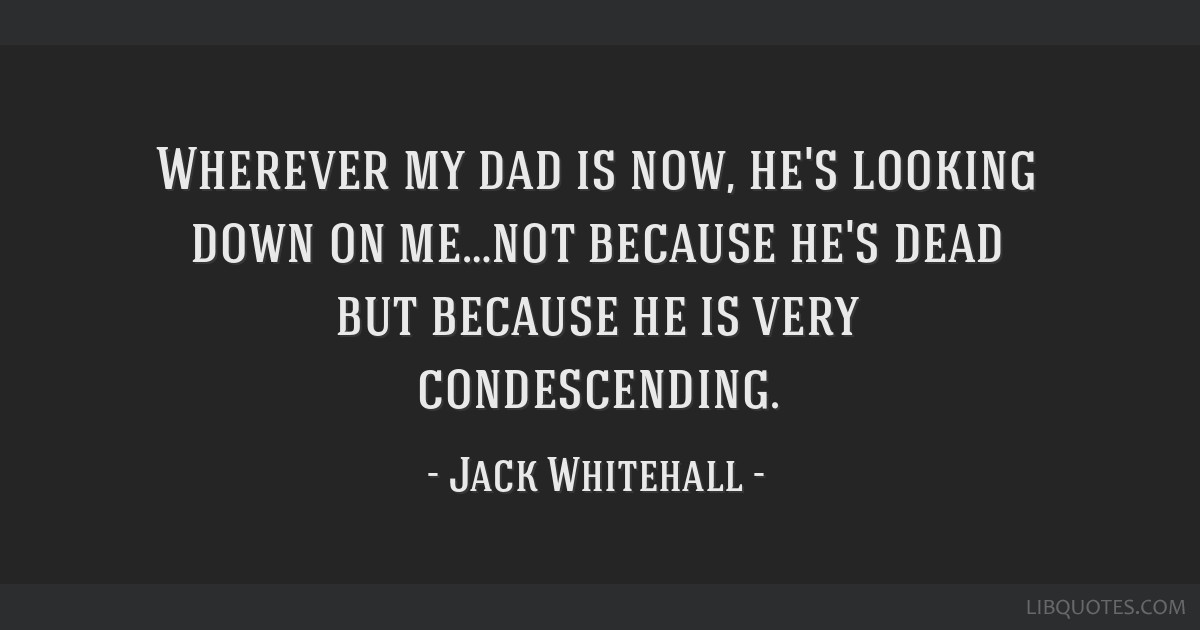
Comedy that lands isn't just about timing or punchlines—it's about truth wrapped in exaggeration. Few modern comedians balance self-deprecation, familial awkwardness, and societal observation quite like Jack Whitehall. His now-famous quip—“I’m sure wherever my dad is, he’s looking down on us. He’s not dead, just very”—is more than a viral one-liner. It's a cultural mirror. Beneath the laughter lies a trenchant commentary on honesty, the performance of work culture, and the contradictions of human nature.
This quote, often shared as a “quote of the day,” resonates because it captures a universal discomfort: the gap between social expectation and personal truth. Let’s unpack why this joke endures—and what it teaches us about living more authentically.
The Anatomy of a Joke That Speaks Volumes
Jack Whitehall's humor often centers on his strained yet affectionate relationship with his father, Michael Whitehall. The “looking down” line flips a cliché—usually reserved for the deceased—into a satire of emotional distance. His father isn’t gone; he’s present but detached, observant yet disengaged. That contradiction is where the humor—and the insight—begins.
But what makes this quote stick isn't just the punchline. It’s the emotional veracity. How often do we say things we don’t mean in professional or social settings? How frequently do we “perform” connection while feeling utterly disconnected?
Whitehall’s joke works because it exposes the absurdity of polite fiction. In doing so, it invites us to question our own defaults—especially in high-pressure environments like the workplace.
The Comedy of Emotional Distance
Consider the setup: - “Looking down on us” implies spiritual presence, wisdom, care. - “He’s not dead, just very…” undercuts that with physical and emotional remove.
The pause before “very” lets the audience lean into the tension. When the punchline lands—“very far away,” “very uninvolved,” “very done with this”—it’s not just funny. It’s relatable. Many of us have colleagues, managers, or family members who are physically present but emotionally absent.
In the workplace, this manifests as leaders who are “available” in title only—checking Slack once a week, attending meetings without engagement, or offering feedback that’s more performance review than genuine support.
Honesty as Disruption in Modern Work Culture
Whitehall’s quote thrives on subverting expectations. That same principle applies to honesty in professional settings. True transparency—admitting mistakes, setting boundaries, voicing dissent—is often treated as disruptive. But the real disruption comes from dishonest harmony: the team that nods along in meetings but sabotages progress in private.
Why Workplaces Avoid Real Honesty
Many companies claim to value “open communication,” yet punish candor. Here’s why:
- Power asymmetry: Employees fear retaliation for speaking up.
- Performance theater: Staying late to look busy, not to be productive.
- Conflict avoidance: “Positive vibes only” cultures that silence dissent.
Jack’s joke works because it’s honest about disconnection. In a work context, we rarely admit when we’re checked out—because we’re supposed to be “passionate” or “aligned.” But pretending engagement is sustainable only until burnout hits.
#### A Real-World Example
Imagine a marketing team launching a campaign. Everyone says “looks great” in the meeting. Privately, three people know the copy is off-brand. But no one speaks up—until after launch, when engagement tanks.
Sound familiar?
Whitehall’s humor reminds us: the truth is funny because it’s suppressed. When we normalize saying what we actually think—without drama, but with clarity—we build healthier cultures.
The Performance of Presence in Human Nature
Human beings are experts at pretending. We show up. We nod. We say “I’m fine” when we’re not. We attend Zoom calls with cameras on and phones scrolling Instagram.
Jack Whitehall’s father, in the joke, is the ultimate symbol of this performance: physically located, spiritually absent. He’s “looking down” not from heaven, but from a balcony—present, but uninvolved.
The “Looking Down” Paradox in Leadership
In organizations, leaders often fall into the same trap:
- They’re present at meetings but distracted.
- They delegate but don’t follow up.
- They claim open-door policies but respond to emails weeks later.
This creates a culture of ambiguity. Teams don’t know if feedback will be heard. Initiatives stall because no one feels ownership.
Whitehall’s joke becomes a metaphor: presence without engagement is a form of absence.
How to Avoid Being the “Very” Person
Here’s a practical checklist to ensure you’re not the “very uninvolved” leader—or colleague:
- Respond within 24 hours, even if it’s just “I’ll get back to you by Friday.”
- Ask follow-up questions in meetings instead of defaulting to “sounds good.”
- Admit when you’re overwhelmed—it gives others permission to do the same.
- Remove performative tasks (e.g., daily stand-ups that last 30 minutes with no action items).
Honesty here isn’t about oversharing. It’s about reducing the gap between appearance and reality.
British Humor as Social Critique
Jack Whitehall operates in a tradition of British comedy that uses wit to dissect class, family, and emotional repression. From Fawlty Towers to The Office (UK), British humor often exposes the absurdity of keeping up appearances.
Whitehall’s quote fits this mold perfectly. It’s not just a dad joke. It’s a critique of British (and global) norms around emotional reserve.
The “Stiff Upper Lip” in the Workplace
The “I’m fine, carry on” attitude doesn’t disappear at the office door. It mutates:
- Employees hide stress to seem “resilient.”
- Managers avoid difficult conversations to keep peace.
- Teams work late not because it’s needed, but because it looks dedicated.
But as Whitehall’s joke suggests: just because someone’s present doesn’t mean they’re participating.
The healthiest teams aren’t the ones with constant smiles. They’re the ones where people can say, “I’m not feeling this,” or “I don’t agree,” without fear.
Applying Jack Whitehall’s Wisdom: 3 Life Lessons
Let’s extract practical value from the humor.
1. Honesty Doesn’t Have to Be Brutal—It Just Has to Be Real
You don’t need to deliver harsh truths like a stand-up roast. But clarity > politeness when it matters.
- Instead of “That presentation was… interesting,” try “I think the data section could be clearer—can we revisit it?”
- Instead of “I’m fine,” try “I’m a bit overwhelmed—can we push this deadline?”
Whitehall’s joke works because it’s truthful, not cruel. Apply that balance.
2. Presence Requires Engagement
Being in the room isn’t enough. Engagement means:
- Active listening (no laptop open during 1:1s).
- Following through on promises.
- Creating space for others to speak.
If your team thinks, “They’re here, but they’re not really here,” you’re the “very” person in the joke.
3. Use Humor to Surface Truth—Not Avoid It
Comedy can be a Trojan horse for hard conversations.
- A lighthearted “I feel like we’re all just pretending to understand this spreadsheet” can open up real discussion.
- Saying “I’m not dead, just very tired” after a long week humanizes you as a leader.
Humor disarms. Use it to connect, not deflect.
Why This Quote Endures in Digital Culture
The line spreads because it’s short, shareable, and shockingly accurate. It’s become a meme template, a caption for photos of disengaged dads, distant bosses, or anyone physically present but mentally checked out.
But its staying power comes from truth. In an age of curated LinkedIn personas and “hustle porn,” Whitehall’s joke is a breath of unfiltered air.
It reminds us: - You don’t have to perform constant enthusiasm. - It’s okay to be distant sometimes—just own it. - The most human moments are often the awkward ones.
Closing: Be Present—Or Don’t Pretend You Are
Jack Whitehall’s “quote of the day” isn’t just comedy. It’s a challenge: stop pretending.
In work and life, we waste energy maintaining appearances. We say we’re fine when we’re not. We attend meetings to be seen, not heard. We “look down” from a distance, playing the part without doing the work.
The alternative? - Be honest about your bandwidth. - Engage—or excuse yourself. - Use humor to reveal truth, not hide it.
You don’t have to be “on” all the time. But when you show up, show up for real. Otherwise, you’re just the punchline.
FAQs
What is Jack Whitehall’s most famous quote? “I’m sure wherever my dad is, he’s looking down on us. He’s not dead, just very…” is among his most quoted lines, often shared for its blend of humor and emotional insight.
What is the context of “he’s not dead, just very”? It’s a recurring joke from Jack Whitehall’s stand-up and Netflix travel documentaries with his father, highlighting their emotionally distant but loving relationship.
How does Jack Whitehall use humor to discuss family? He uses self-deprecating and observational comedy to expose the awkwardness, love, and miscommunication in familial relationships—especially with his reserved father.
What can we learn about work culture from this quote? It illustrates how presence without engagement is common in workplaces—leaders and teams often “show up” without truly participating, harming trust and productivity.
Is Jack Whitehall’s comedy relatable outside the UK? Yes. While rooted in British class and family dynamics, themes of emotional repression, workplace performance, and generational gaps have global appeal.
How can I apply this quote to leadership? Use it as a reminder: being physically present isn’t enough. True leadership requires active listening, follow-through, and emotional availability.
Why do people share this quote as “quote of the day”? It’s concise, humorous, and layered—working as both a laugh and a mirror to our own tendencies to disengage while pretending to participate.
FAQ
What should you look for in Jack Whitehall’s Quote of the Day on Life, Work, and Honesty? Focus on relevance, practical value, and how well the solution matches real user intent.
Is Jack Whitehall’s Quote of the Day on Life, Work, and Honesty suitable for beginners? That depends on the workflow, but a clear step-by-step approach usually makes it easier to start.
How do you compare options around Jack Whitehall’s Quote of the Day on Life, Work, and Honesty? Compare features, trust signals, limitations, pricing, and ease of implementation.
What mistakes should you avoid? Avoid generic choices, weak validation, and decisions based only on marketing claims.
What is the next best step? Shortlist the most relevant options, validate them quickly, and refine from real-world results.